
Category: Polio News
Our polio video project is under way


Videotaping began this week on the polio educational video being created as a joint effort by the Southern Rensselaer County Rotary Club, CASDA, District 7190, and the UAbany School of Public Heath.
The aim is to have the video, which is being underwritten by CASDA, completed in time for a debut showing at the District Conference in Lake George in May.
It is expected that the final product will be available in three different lengths to accommodate different needs.
District Governor John Mucha is narrating the video, which includes Jim Leyhane interviewing Dr. Martha Lepow, an early pioneer in polio research and the Director of Excellence In Pediatric and Adolescent Care at Albany Medical Center. In addition to CASDA providing the technical crew at no cost to the club, members of SRC, the District and the School of Public Heath are volunteering their time.
Progress finally being made in polio fight in Pakistan
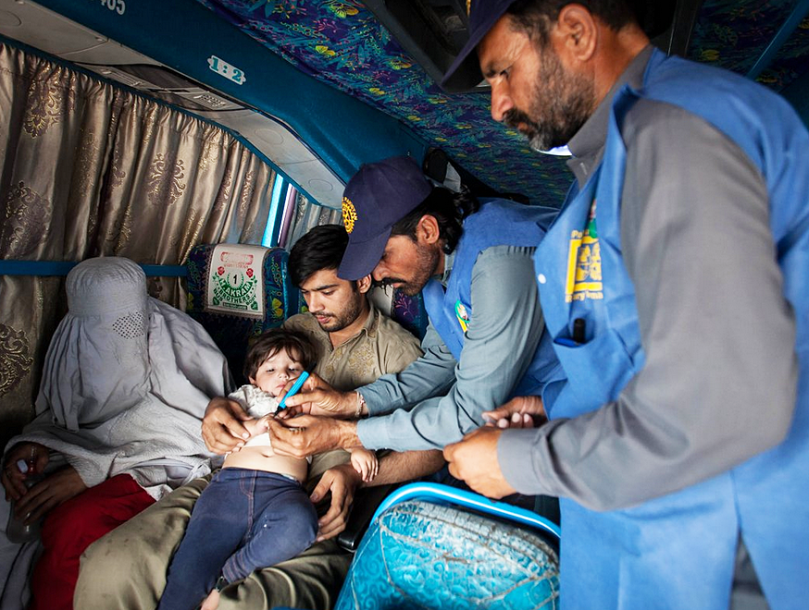
Pakistan is one of the few countries in which polio is endemic. In addition to having to overcome violent resistance by anti-Western terrorists to polio immunization programs, Rotary is working to minimize the difficulty of treating migrant population.
Go here for a dramatic story describing the situation, and showing what our ongoing support of polio immunization efforts now is accomplishing with the cooperation pf Pakistani government and health entities after years of neglect.
Is this the kind of DG you like?

Fred Daniels, who will become our District Governor on July 1 but already has made himself a strong presence on the 7190 scene, manages a grin as he emerges chilly but relatively unscathed from the New Year’s Day “Polar Plunge” in Lake George, an annual fundraiser for Rotary’s ongoing fight against polio.
Fred’s friends pledged $1,050 for him to go in up to his neck in the lake during the event. Current DG John Mucha has announced that if all pledges and matching funds are realized, 7190 will have raised about $30,000 through this year’s plunge.
(Thanks to Christine Daniels for the photo.)
Lake jumpers, bowlers shoot for $30K mark
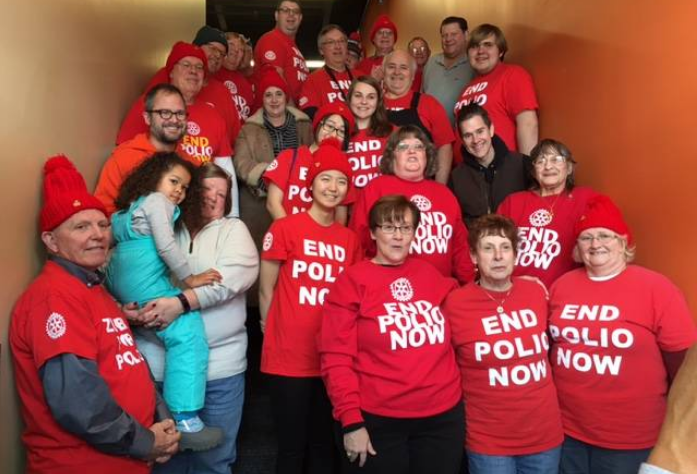
On New Year’s Day, a hardy band of District 7190 Rotarians participated in the annual “Polar Plunge” at Shepard Park in Lake George.
The go-jump-in-the-lake event in frigid waters is a major fundraiser for Rotary’s anti-polio efforts.
To warm up afterward, they joined other Rotarians in the annual “Bowl Over Polio” event.
Says District Governor John Mucha, “We’re hoping to exceed $10,000 with pledges and donations, and with the [Bill & Melinda] Gates [Foundation] match, that’s $30,000 to fight polio. ”
He won’t quit; we shouldn’t either
This first-person testimony shows that not all polio cases are the same. And, it shows what your ongoing support can accomplish.
How is Nigeria Rotary reacting to polio flareup?

• From AllAfrica.com
A group of Rotary Clubs in the area of Lagos and its suburbs in northern Nigeria just carried out a polio walk across several communities to mark World Polio Week. Despite the belief that the African nation was polio free, several cases recently were reported in the area that had been in the hands of Boko Harum terrorists who forbade immunization.
Eboigbe Olaiye, assistant governor of District 9110 which covers Lagos and nearby cities, said the purpose of the walk was to create awareness of polio. He called on parents to take their children to the nearest primary health center for polio immunization, while urging the national government to create more awareness and emphasize to people living in rural areas that the vaccine is free.
Santoch Kakade, chairman of Rotary’s Polio Service and Blood Donation, said the sudden outbreak of polio requires renewed sensitization in Nigeria.
District 9110 last Saturday brought together students from various schools with a target of 4,500 to break the Guinness Book of World Records’ human mosaic record of 4,200 people. Dr. Tunki Funsho, chairman of Nigeria’s National Polio Plus Committee and a past district governor, said the effort was to create more awareness towards eradication of polio in Nigeria.
In a related development, the Rotary Club of Amuwo also staged an awareness campaign through the media on plans to eradicate the disease. It called on members of the public to donate funds to the Global Polio Eradication Initiative (GPEI).
Club President Aniekan Essienette said, “Our call to action is to enlighten the public to report any new case of limb weakness among children up to age 15 to the local council authorities or World Health Organization (WHO) close to them.”
Why public service projects are a good investment

• From the October 2016 issue of The Rotarian
Tom Frieden is a little out of breath. He just climbed the stairs from a meeting to his office on the top floor of the 12-story headquarters of the U.S. Centers for Disease Control and Prevention in Atlanta.
“I did that because we have a beautiful stairway in this building. I can look outside, and I get better email coverage on the stairs than I do in the elevator,” the CDC director says. His trip up the stairs sums up his view on one of the tenets of his work: “The sweet spot of public health is making the healthiest thing to do the default value — in other words, the easiest thing to do.”
Frieden took his post in 2009 after stopping the largest outbreak of drug-resistant tuberculosis in U.S. history in New York City, helping establish TB treatment programs in India that have saved more than 3 million lives, and serving seven-plus years as health commissioner of New York City. There, he worked with Mayor Michael Bloomberg to make all restaurants and bars smoke-free, making New York the first major city to do so outside California. His controversial policies had him criticized as a “nanny” in some circles, and lauded as a visionary in others.
‘The thing that worries us from a public health standpoint … is the potential of an influenza pandemic. … We’re still not as prepared as we’d like to be. We don’t have the vaccines we’d like, and the virus is … constantly mutating.’
As head of the U.S. public health system, Frieden has taken on everything from ebola to the flu. But, where his work most closely intersects with Rotary’s is in polio eradication –- CDC joins Rotary, UNICEF, the Bill & Melinda Gates Foundation, and the World Health Organization (WHO) as a core partner in the Global Polio Eradication Initiative. CDC deploys scientists to investigate outbreaks of polio, identify the strain of poliovirus involved, and pinpoint its geographic origin.
“Rotary has done such a phenomenal job for so many decades on this, and now we are poised to get over the finish line and end polio once and for all,” Frieden said in an interview with Rotarian senior editor Diana Schoberg about ending polio and the best buys in public health.
THE ROTARIAN: Polio has been eradicated in the U.S. since 1979. Why does CDC stay involved?
FRIEDEN: CDC takes polio eradication very seriously. We focus on supporting the front lines wherever polio continues to spread. I am deeply engaged with all aspects of the response and support for our team. That includes laboratory work, community outreach, organization of the response, extension of the capacity of local doctors and outreach workers, and tracking cases so we can target our responses and get to the last bastions of polio in the world.
TR: The estimated funding gap to eradicate polio is $1.5 billion. Why is it such a large number?
FRIEDEN: It costs a lot because as long as there’s still polio anywhere, every country needs to continue to act as if polio could get reintroduced. Every year polio is not eradicated will cost another $800 million. You need vaccines, surveillance, and social mobilization. All of that takes people and money. Up to 400 million children still need to be immunized every year, and surveillance in up to 70 countries needs to not only continue, but be intensified, to ensure we are finding all possible cases of polio for as long as polio may be spreading.Read More »
Another celeb joins anti-polio push
A former First Daughter has joined Rotarians and others working around the globe to eradicate the scourge of polio, a disease her family knows well because her father-in-law was struck by it as a youth. We also have posted this video on our club’s Facebook page and urge you to go there and “share” it on your own page to help spread the word.
Polio vaccine makers failing to make enough, endangering program
 • From Reuters News Service
Two companies making vaccines to help the world eradicate polio are failing to produce enough, so many countries should prepare to give lower doses to make stocks last, a group of experts has advised the World Health Organization (WHO).
With polio on the brink of eradication globally, the WHO wants to see a worldwide switch from the traditional “live” oral polio vaccine, which runs the risk of spreading the disease, to an inactivated vaccine that needs to be injected.
But, WHO’s Strategic Advisory Group of Experts (SAGE), which meets twice a year, said a severe shortage of inactivated vaccine means many countries should use a fractional dose, via an intra-dermal rather than intra-muscular injection, allowing each dose to go twice as far.
“There are only two manufacturers of the vaccine, and they are having some problems with production of the vaccine, and getting enough raw material of the polio virus,” SAGE Chairman Jon Abramson told reporters on a conference call.
Polio is a contagious viral disease that invades the nervous system and can cause irreversible paralysis within hours, and sometimes respiratory failure and death.
“Each time we hear that there’s a further reduction in the amount that can be anticipated, we have to make further adjustments,” Abramson said. “My hope is this problem can be Read More »
 Southern Rensselaer County Rotary Club