Update: Despite tragedy, ShelterBox cyclist completes global ride

Screen shot 2016-06-18 at 4.03.50 PM
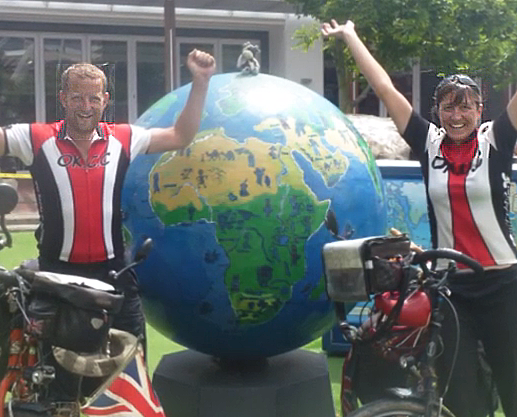
Tim and Sharon Bridgman at the start of their planned global ride.

UPDATE: Tim Bridgman has completed his bicycle journey around the globe, finishing the trek when he rode into Prudhoe Bay, Alaska. Go here for a story of his venture published by his hometown English newspaper, the Express & Echo. Our original story is below.


(Originally published 6/18/16)

Go here for a CNN story and video on this remarkable journey.

On June 4, 2012, Sharon and Tim Bridgman set off from Norway to cycle unsupported and self-funded around the world to raise awareness and support of ShelterBox.

They rode through Scandinavia, Eastern Europe, and East Africa to Capetown, South Africa, passing through 23 countries and covering 15,939 miles. They then headed to the southern tip of Argentina and rode north, passing between Chile and Argentina before reaching Bolivia. At this point they had covered just under 21,000 miles through 26 countries.

On April 26, 2014, in a remote area of southwest Bolivia just seven weeks short of their second anniversary on the trek, Sharon was hit by a truck and was killed instantly.

Tim was devastated at the loss of his wife and best friend. But, after taking off several months, he felt compelled to finish in light of so many families losing loved ones in an instant from natural disasters or civil unrest.

Warmly welcomed by volunteers, Rotarians and Rotary Clubs along the way, Tim cycled through the California, Nevada, Oregon, and Washington, and currently is making his way through British Columbia and is several weeks away from Prudhoe Bay, Alaska, where he will complete the journey he and Sharon began in 2012.

A local tie to a Peruvian humanitarian effort

Abigale
Abigale Stangl (left in purple sweater) works with young Peruvian women. The current cover of The Rotarian is in the background.

A family member of SRC’s own Becky Raymond is featured in an article in the latest issue of The Rotarian, RI’s international magazine. As Becky reports:

“When reading the August issue of The Rotarian … I was delighted to find an article featuring my niece, Abigale Stangl, and her work in Peru with young girls. This work is really making a difference for the future of the girls.

“Abby is one of the reasons I decided to join Rotary. She has been active in Rotary since high school and is now getting her Ph.D at the University of Colorado. Rotary has been a foundational part of her life, supporting her to study and work in Sweden, New Zealand, and Peru. She is an inspiration.”

The article, titled “The Visionaries,” deals with a project begun in 2012 that seeks to improve the lives of poor and unempowered young Peruvian women trying to escape poverty and abuse. It notes, “Abigale Stangl, who has been working alongside one of her instructors at the University of Colorado to produce metrics that show how well the project works, ‘got on board as soon as I heard about the project,’ she recalls.”

You will find the article on pages 46-51 in your copy of the August 2016 edition of The Rotarian.


If you’ve ever wondered if Rotary is growing …

Screen shot 2016-07-21 at 4.09.07 PM
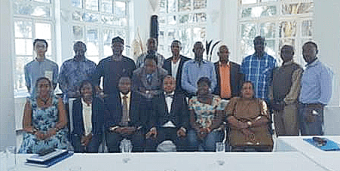
The new club’s charter members.

From The Point for Freedom & Democracy

A new Rotary club has been formed in The Gambia, called the Brusubi Rotary Club, the third Rotary club in the African nation.

The Gambia now has the Banjul Rotary Club, Fajara Rotary Club and the Brusubi Rotary Club.

The Rotary Club of Brusubi executive members are Rotarian Kareem Martins as the Chartered President, Michael Barrai as the Chartered Secretary and Elizabeth Samba as the Chartered Treasurer.

The Rotary Club of Brusubi was admitted to membership into Rotary International (RI) on 24 June 2016. The Gambia and nine other countries constitute the District 9101 of Rotary International.

Go here for the rest of the story.


1st message from new RI president

Screen shot 2016-07-13 at 4.47.09 PM
John F. Germ

• John F. Germ of Chattanooga, TN, took office as president of Rotary International on July 1. In this, his first message, he sets the tone for his term in office.

Today, we look ahead toward a Rotary year that may one day be known as the greatest in our history: the year that sees the world’s last case of polio.

Wild poliovirus caused only 74 cases of polio in 2015, all of them in Afghanistan and Pakistan. As we continue to work tirelessly toward our goal of eradication, we also must look beyond it, preparing to leverage our success into even greater successes to come.

It is tremendously important to Rotary’s future that our role in the eradication of polio be recognized. The more we are known for what we’ve achieved, the more we’ll be able to attract the partners, the funding, and, most important, the members to achieve even more. We’re working hard at RI headquarters [in Evanston, IL] to be sure that Rotary gets that recognition.


Every day that you serve in Rotary, you have the opportunity to change lives.
Everything you do matters.


But, it can’t all happen there. We need you to get the word out through your clubs and in your communities about what Rotary is and what we do. We need to be sure that our clubs are ready for the moment when polio finally is eradicated, so that when people who want to do good see that Rotary is a place where they can change the world, every Rotary club is ready to give them that opportunity.

We know that if we want to see [the motto] “Rotary Serving Humanity” even better in the years ahead, we’ll need more willing hands, more caring hearts, and more bright minds to move our work forward. We’ll need clubs that are flexible, so Rotary service will be attractive to younger members, recent retirees, and working people. We’ll need to seek out new partnerships, opening ourselves more to collaborative relationships with other organizations.

Looking ahead, we also see a clear need to prioritize continuity in our leadership. We in Rotary all are playing on the same team, working toward the same goals. If we want to reach those goals together, we all have to move in the same direction, together.

Every day that you serve in Rotary, you have the opportunity to change lives. Everything you do matters; every good work makes the world better for us all. In this new Rotary year, we all have a new chance to change the world for the better, through “Rotary Serving Humanity.”


Looking for project ideas? Try the Rotary Showcase

Tracker
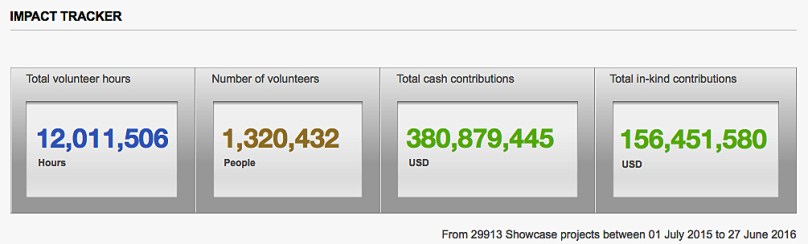
Here’s what can  happen in a single year.

It may sometimes seem like all the good public service ideas have been taken. Don’t fool yourself. Energetic, imaginative Rotarians around the globe keep coming up with ways to improve the world.

Screen shot 2016-06-27 at 3.47.42 PMThe impact tracker shown above gives you an idea what has been accomplished in just this Rotary Year. And, we’re always looking for ideas large and small that we can put into action. As SRC Board member Jim Leyhane usually explains to new members during their induction, “No one can do everything, but everyone can do something.”

If you’re looking for ideas for a project that may interest you, one you’d like to discuss with your club, check out the “Rotary Showcase” website for inspiration. It has a slideshow of projects, and an easy-to-use dropdown search facility that lets you browse the database by category, topic, location, and other terms.


ShelterBox challenge: Can you go ‘Off the Grid’?

Screen shot 2016-06-23 at 3.20.15 PM Scroll down to see invitations and sponsorship forms.

Many of us joke that we know people who can’t be parted from their many electronic devices for even a minute. Are you one of those electronic slaves?

Screen shot 2016-06-23 at 3.24.45 PMThere’s a way to find out on the weekend of July 16-17. Take the “Go Off the Grid for ShelterBox” challenge.

This could be an interesting family experiment, seeing that even though you’d have no power you still would not be powerless. By taking part, you’ll get a sense of what life is like for families who lost everything when disaster struck — the kind of people your ShelterBox contributions help around the world. They are forced to live  without electricity, no light, no safety, no place to cook and keep warm. No shelter over their heads.

If you, or you and your family, decide to “Go Off the Grid” it will mean no texting, no downloading, no videos, no tweeting, no music, no TV, no video games, not even lights, for a period of 24 consecutive hours during the designated weekend. But, that doesn’t mean you’d have to sit around like stunned sheep. You can download tips or order an “Off The Grid Survival Box,” packed with BBQ recipes, games, activities and other ideas from the folks at ShelterBox to keep the whole family connected — to each other.

The intent of the challenge is to raise awareness of just how difficult life is without the many everyday things we take for granted, and in doing so to increase interest in donating to ShelterBox. Of course, you can always do that without taking the challenge, but it’s a fascinating idea that your entire family will remember.

You don’t have to be a Rotarian to support ShelterBox. Throw a backyard cookout — call it an “OFF THE GRIDdle BBQ”), invite friends and neighbors (be sure to tell them no phones, tablets, etc., allowed.) Here’s an official invitation …

Screen shot 2016-06-23 at 3.31.51 PM

… and, you can download free copies of it by clicking here. Then, simply send the donations along to ShelterBox. (You also can direct your invitees to our website where they can find details on what ShelterBox is all about.)

Another way to raise funds for ShelterBox is to use the 24-hour event the same way you would a walk-athon, a bike-athon, etc. Get sponsors. Here’s what the official pledge form looks like …


Screen shot 2016-06-23 at 3.41.14 PM


… and, you can download free copies by clicking here. Then, just as you would with cookout donations, send the money along to ShelterBox.


Update: Despite tragedy, ShelterBox cyclist completes global ride

Screen shot 2016-06-18 at 4.03.50 PM
Tim and Sharon Bridgman at the start of their planned global ride.

UPDATE: Tim Bridgman has completed his bicycle journey around the globe, finishing the trek when he rode into Prudhoe Bay, Alaska. Go here for a story of his venture published by his hometown English newspaper, the Express & Echo.


(Originally published 6/18/16)

Go here for a CNN story and video on this remarkable journey.

On June 4, 2012, Sharon and Tim Bridgman set off from Norway to cycle unsupported and self-funded around the world to raise awareness and support of ShelterBox.

They rode through Scandinavia, Eastern Europe, and East Africa to Capetown, South Africa, passing through 23 countries and covering 15,939 miles. They then headed to the southern tip of Argentina and rode north, passing between Chile and Argentina before reaching Bolivia. At this point they had covered just under 21,000 miles through 26 countries.

On April 26, 2014, in a remote area of southwest Bolivia just seven weeks short of their second anniversary on the trek, Sharon was hit by a truck and was killed instantly.

Tim was devastated at the loss of his wife and best friend. But, after taking off several months, he felt compelled to finish in light of so many families losing loved ones in an instant from natural disasters or civil unrest.

Warmly welcomed by volunteers, Rotarians and Rotary Clubs along the way, Tim cycled through the California, Nevada, Oregon, and Washington, and currently is making his way through British Columbia and is several weeks away from Prudhoe Bay, Alaska, where he will complete the journey he and Sharon began in 2012.

3rd ‘World Polio Day’ scheduled for October

Screen shot 2016-06-13 at 2.38.44 PM

Do you know how much it costs to provide oral polio vaccine for one child?

The answer is a mere 60 cents. That’s a small price to pay for a life free from a contagious disease that once spread paralysis, limb deformities, respiratory obstructions, and death in every country on Earth.

That is why Rotary International has been so relentless in its fundraising and vaccine distribution to combat a disease that cannot be cured but can be prevented. We’ve got it down to just two countries where polio is endemic — Pakistan and Afghanistan. But, because polio is so easily spread, a rigorous and ongoing program of vaccinations is a must.

The 3rd annual “World Polio Day” this year is scheduled for October 24. For every dollar donated by a Rotarian, the Bill & Melinda Gates Foundation will triple it. You can find details on what you can do to help by clicking here.

For those among us fortunate enough to grow up in a world without polio and raise their children without the fear of it, the question “What IS polio?” is understandable. We have an answer for that on a separate page elsewhere on this website. Just click here.


For RI president, polio hit home early

prez
K.R. Ravindran

From Rotary International

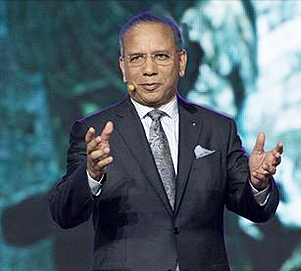
Rotary International President K.R. Ravindran closed the recent RI convention in Seoul, South Korea, with this poignant story about his mother’s fight to survive polio — at the age of 30.

When Ravindran was 11 years old in his native Sri Lanka, his mother awoke one day feeling weak and short of breath. Sitting down to rest, she found herself unable to move. The polio virus had quickly invaded her nervous system, resulting in paralysis.

She was placed in an iron lung at the hospital to enable her to breathe, and was told that her chances of walking, or even surviving without a ventilator, were slim. But most Sri Lankan hospitals were not equipped with ventilators in 1963.

Ravindran’s grandfather, a Rotary member, hosted a club committee meeting in his living room the evening after his daughter was rushed to the hospital. Rather than simply offer


“There are people on this planet whose lives are better now because you traversed this earth. And, it doesn’t matter if they know that or not. It doesn’t matter if they even know your name or not. What really matters is that your work touched lives; that it left people healthier, happier, better than they were before.”

— K.R. Ravindran’s closing remarks as RI president


consolation, his fellow members went to work, using their business acumen and professional connections to find a ventilator.

One of the members was a bank manager who called a government minister to facilitate a quick international transfer of funds. Another member, a manager at SwissAir, arranged to have a ventilator flown in. The next day, it arrived at the hospital.

“There was so much red tape at the time in Sri Lanka, but somehow, those Rotarians made it all fall away,” Ravindran told the audience.

Ravindran’s mother spent a year and a half in a hospital bed, but her condition gradually improved. She eventually left the hospital walking — with a walker, but upright, on her own two feet.

“Fifty-three years ago, my mother’s life was perhaps one of the very first to be saved from polio by Rotarians,” Ravindran said. “We have saved millions of lives since then. Tonight, I stand before you Read More »