
Update on ‘Adopt-a-Family’ project

adopt-a-family-logoUPDATE (11/18/16): From April Dowd: I have just learned that the family we will be helping through Circles of Mercy this holiday season has received some devastating news. Darlene, the 70-year-old household head who is caring for her three great-grandchildren, has been diagnosed with cancer. Given that she will be faced with unexpected medical-related bills, we are expanding the needs/wish list for the family.

In addition to the list circulated this week to all members, I would like to emphasize the need for gift cards — preferably for WalMart, where Darlene can shop for food and everyday needs, and for gasoline to help her get to her medical appointments and all the driving needed for the kids. And, obviously, we will be donating more clothes for the kids than were on the original list.

Please, those of you who have not yet replied to my original message, let me know what you would like to contribute. Thank you.

(Originally posted 11/16/16)

Once again, we are working with the local family services agency Circles of Mercy to make the holidays brighter for a family in need.

Richard Zazycki, Circles’ executive director, has just sent us the “need/wish list” of items for this year’s “Adopt-a-Family” project. Our assigned family is a bit different this year. The head of it is a 70-year-old great-grandmother who has custody of, and cares for, three children — two girls and one boy, ages 4 to 6.

To avoid duplication or omission, project coordinator April Dowd says she would appreciate it if anyone wishing to help would send me a note in advance of shopping, specifying what item they wish to purchase. She then will coordinate your responses and get back to everyone on what they can contribute. Obviously, overall we can contribute more than one of each item, so more of our members can be involved.

As in the past, you will need to wrap all gifts and label each with the appropriate name. The deadline for delivering gifts to Circles of Mercy is Friday, December 16. To accomplishRead More »
The real story of the day that preempts us next week

Since we won’t be meeting for Thursday evening Rotary dinner again until next month, it may be interesting to take a fresh look at what will preempt us next week. It’s the 153rd annual Thanksgiving Day.

Yes, 153rd. Not the 396th as some people think. True, the Pilgrims and the indigenous Wampanoags did share an autumn harvest feast that is acknowledged as the first such fete in the New World although there is no record extant that they ever gave it a title. And, they held a similar three-day party the following year, but it kind of dissipated as time went on.

And, yes, some sorts of harvest-period celebration have been commonplace in most parts of then world from time immemorial, so it is not surprising that the practice endured in one form or another. In the early years of our nation, presidents George Washington and John Adams issued proclamations about national days of thanks, but they were not necessarily regarded as national holidays and the practice fizzled. In 1817, New York State became the first of several U.S. states to officially adopt an annual Thanksgiving holiday, although each celebrated it on a different day.Read More »

Celebrating Labor Day

Mural

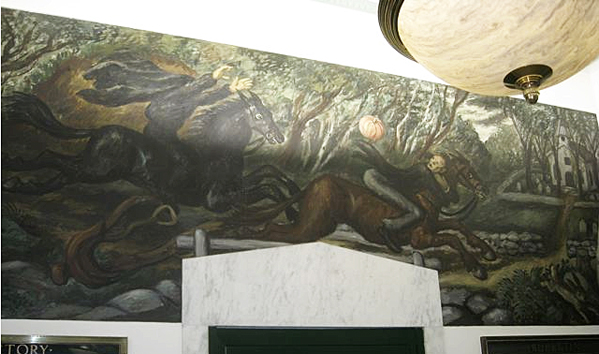
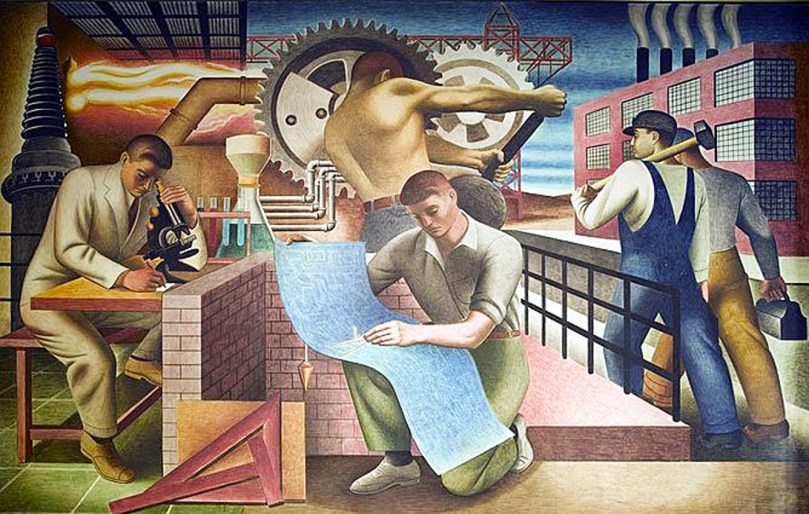
This is one of many murals painted by artists across the country as part of the federal Works Progress Administration (WPA) from 1934 to 1943 to celebrate the range and energy of the American labor force.

If you’re not familiar with the Federal Art Project category of the WPA’s efforts at rebuilding the nation as we came out of the Great Depression — or even if you are and haven’t seen examples in a while — you can find a lot of information online. And, you can find an 11-image slideshow here from The New York Times.

In Rensselaer County, the main U.S. Post Office on Broadway in Troy has such art on its lobby walls. Seen below are “Rip Van Winkle” and “Legends of the Hudson,” both painted in 1938 by Waldo Pierce.

LegendsRip


July 2, perhaps the real Independence Day

Screen shot 2016-07-02 at 2.18.13 PMNot many holidays have multiple names. True, if you say them in different languages they do, but not when they’re all in English.
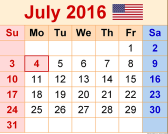
We speak here of the upcoming July 4th. Or, the Fourth of July. Or, Independence Day. Internationally, it also is known as the National Day of the United States. That’s four.

School children are taught that July 4, 1776, is when we declared our independence from England. Technically, perhaps, but that actually was done two days earlier when the Second Continental Congress voted to approve a resolution that had been proposed the month before by Richard Henry Lee of Virginia, declaring the United States independent from the rule of Great Britain.

Congress then turned its attention to the Declaration of Independence, the written statement explaining this decision, which had been prepared by a Committee of Five, with Thomas Jefferson as its principal author. It debated and revised the wording of the Declaration, finally approving it on Thursday, July 4, the day that became one of celebration and commemoration.

That isn’t exactly what all the Founding Fathers had in mind at the time. On July 3, John Adams had written to his wife, Abigail (underlining for emphasis):

“The second day of July, 1776, will be the most memorable epoch in the history of America. I am apt to believe that it will be celebrated by succeeding generations as the great anniversary festival. It ought to be commemorated as the day of deliverance, by solemn acts of devotion to God Almighty. It ought to be solemnized with pomp and parade, with shows, games, sports, guns, bells, bonfires, and illuminations, from one end of this continent to the other, from this time forward forever more.”

While we enjoy our picnics, fireworks, parades, and games, let’s take a moment to reflect on the tremendous achievement that was wrought 240 years ago this weekend.


What’s so special about this July?

Screen shot 2016-07-01 at 10.06.07 AMWelcome to July 2016. What’s the big deal, you may say? The month comes around every year.

Ah, but not THIS sort of July. Check the calendar and you’ll notice something different. It has five Fridays, five Saturdays, and five Sundays. For those of you who live for the weekends, soak it in. This occurence comes around only once every 823 years!

Today, of course, is Canada Day, our northern neighbor’s official birthday, and Monday will be our own Fourth of July. But, they are not the only special days in July. Try these on for size:

2nd — World UFO Day
4th — National Country Music Day; Sidewalk Egg Frying Day
6th — International Kissing Day
8th — National Blueberry Day
10th — Teddy Bear Picnic Day
15th — Tapioca Pudding Day;  Cow Appreciation Day
20th — National Lollipop Day
21st — National Junk Food Day
23rd — National Hot Dog Day
24th — Parent’s Day (fourth Sunday in July)
26th — Aunt and Uncle Day
28th — National Milk Chocolate Day
29th — National Lasagna Day
30th — National Cheesecake Day

And, the 30th is a perfect day for Rotarians. It is the International Day of Friendship.


The origins of Father’s Day in the U.S.

Screen shot 2016-06-18 at 4.18.30 PM

From History.com

Screen shot 2016-06-18 at 4.17.45 PMOn July 19, 1910, the governor of the state of Washington proclaimed the nation’s first “Father’s Day.” However, it was not until 1972 — 58 years after President Woodrow Wilson made Mother’s Day official — that the day became a nationwide holiday in the United States. This year it is being celebrated on Sunday, June 19.
Origin of Mother’s Day

The “Mother’s Day” we celebrate today has its origins in the peace-and-reconciliation campaigns of the post-Civil War era. During the 1860s, at the urging of activist Ann Reeves Jarvis, one divided West Virginia town celebrated “Mother’s Work Days” that brought together the mothers of Confederate and Union soldiers. In 1870, the civic activist Julia Ward Howe issued a “Mother’s Day Proclamation” calling on a “general congress of women” to “promote the alliance of the different nationalities, the amicable settlement of international questions, [and] the great and general interests of peace.”

However, Mother’s Day did not become a commercial holiday until 1908, when — inspired by Jarvis’s daughter Anna, who wanted to honor her own mother by making Mother’s Day a national holiday — the John Wanamaker department store in Philadelphia sponsored a service dedicated to mothers in its auditorium. Thanks in large part to this association with retailers, who saw great potential for profit in the holiday, Mother’s Day caught on right away. In 1909, 45 states observed the day, and in 1914, President Wilson approved a resolution that made the second Sunday in May a holiday in honor of “that tender, gentle army, the mothers of America.”

Origins of Father’s Day

The campaign to celebrate the nation’s fathers did not meet with the same enthusiasm, perhaps because, as one florist explained, “fathers haven’t the same sentimental appeal that mothers have.”

On July 5, 1908, a West Virginia church sponsored the nation’s first event explicitly in honor of fathers, a Sunday sermon in memory of the 362 men who had died in the previous December’s explosions at the Fairmont Coal Company mines in Monongah, WV, but it was a one-time commemoration and not an annual holiday. The next year, a Spokane, WA,  woman named Sonora Smart Dodd, one of six children raised by a widower, tried to


• See who the editors of History.com picked as “History’s Best and Worst Dads.”


establish an official equivalent to Mother’s Day for male parents. She went to local churches, the YMCA, shopkeepers and government officials to drum up support for her idea. She  was successful: The state of Washington celebrated the nation’s first statewide Father’s Day on July 19, 1910.

Slowly, the holiday spread. In 1916, President Wilson honored the day by using telegraph signals to unfurl a flag in Spokane when he pressed a button in Washington, DC. In 1924, Read More »

Pause for a moment and remember

Screen shot 2016-06-06 at 3.32.02 PM

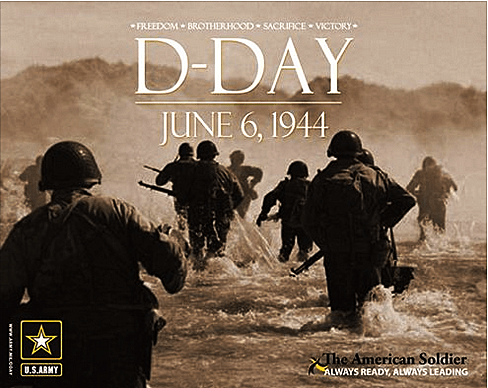
On June 6, 1944, more than 160,000 Allied troops landed along a 50-mile stretch of heavily-fortified French coastline, to fight Nazi Germany on the beaches of Normandy, France.

General Dwight D. Eisenhower, the Supreme Commander of Allied Forces, called the operation a crusade in which “we will accept nothing less than full victory.”

More than 5,000 ships and 13,000 aircraft supported the D-Day invasion. By day’s end, the Allies gained had a foothold in continental Europe. The cost in lives was high. More than 9,000 Allied soldiers were killed or wounded, but their sacrifice allowed more than 100,000 soldiers to begin the slow, hard slog across Europe, to defeat Adolf Hitler’s crack troops.

Go to the U.S. Army website for more information on D-Day.


The origins of Memorial Day

Screen shot 2016-05-30 at 2.12.08 PM.png

• From The History Channel

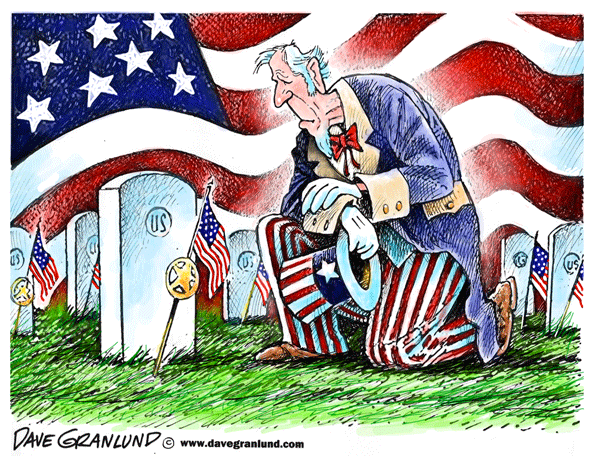
Memorial Day, an American holiday observed on the last Monday of May, honors men and women who died while serving in the U.S. military. Originally known as Decoration Day, it originated in the years following the Civil War and became an official federal holiday in 1971. Many Americans observe Memorial Day by visiting cemeteries or memorials, holding family gatherings and participating in parades. Unofficially, at least, it marks the beginning of summer.

Early Observances of Memorial Day

The Civil War claimed more lives than any conflict in U.S. history, requiring the establishment of the country’s first national cemeteries. By the late 1860s Americans in various towns and cities had begun holding springtime tributes to these countless fallen soldiers, decorating their graves with flowers and reciting prayers.

Did You Know?

Each year on Memorial Day a national moment of remembrance takes place at 3:00 p.m. local time.

It is unclear where exactly this tradition originated; numerous different communities may have independently initiated the memorial gatherings. Nevertheless, in 1966 the federal government declared Waterloo, NY the official birthplace of Memorial Day. Waterloo — which had first celebrated the day on May 5, 1866 — was chosen because it hosted an annual, community-wide event, during which businesses closed and residents decorated the graves of soldiers with flowers and flags.

Decoration Day

On May 5, 1868, General John A. Logan, leader of an organization for Northern Civil War veterans, called for a nationwide day of remembrance later that month. “The 30th of May, 1868, is designated for the purpose of strewing with flowers, or otherwise decorating the graves of comrades who died in defense of their country during the late rebellion, and whose bodies now lie in almost every city, village and hamlet churchyard in the land,” he proclaimed. The date of Decoration Day, as he called it, was chosen because it wasn’t the anniversary of any particular battle.

On the first Decoration Day, General James Garfield made a speech at Arlington National Cemetery, and 5,000 participants decorated the graves of the 20,000 Union and Confederate soldiers buried there. Many Northern states held similar commemorative events and reprised the tradition in subsequent years; by 1890 each one had madeRead More »