

Today in history

Screen shot 2016-06-19 at 2.36.37 PM

On July 5 …

1687 — Isaac Newton publishes his famous multi-volume “Philosophiæ Naturalis Principia Mathematica.” Among other works, the collection includes Newton’s laws of motion, which formed the foundation of classical mechanics, as well as Newton’s law of universal gravitation.

1811 — Venezuela becomes the first country in South American to declare independence from Spain, which had begun colonizing it in 1522.

1916 — Sisters Adelina and Augusta Van Buren — descendants of President Martin Van Buren of Kinderhook — set out from the Sheepshead Bay race track in New York City en route to making the first successful transcontinental motorcycle tour by two women. They will arrive in San Diego, CA, on September 12, ending a 5,500 mile trek. Both are in the American Motorcycle Association Hall of Fame.

1975 — Arthur Ashe becomes the first black man to win a Wimbledon singles title defeating Jimmy Connors.

1996 –- Dolly the sheep becomes the first mammal cloned from an adult cell. The cloning was performed was by Sir Ian Wilmut, Keith Campbell and colleagues at the Roslin Institute, part of the University of Edinburgh, Scotland, and the biotechnology company PPL Therapeutics, based nearby. Dolly would live nearly seven years before succumbing to a progressive lung disease.


Today in history

Screen shot 2016-06-19 at 2.36.37 PM

On July 4 in …

1776 — The United States Declaration of Independence from Great Britain is adopted by the Second Continental Congress meeting in Philadelphia. Delegates from 12 of the 13 Colonies were present when the Congress convened. Georgia had not participated in the First Continental Congress and did not initially send delegates to the Second Continental Congress.

1802 — The United States Military Academy opens at West Point, NY, in Orange County opens.

1826 –- Thomas Jefferson, third president of the United States, dies the same day as John Adams, second president of the United States. It is the 50th anniversary of the adoption of the Declaration of Independence.

1827 -– Slavery is abolished in New York State. The state had passed a law in 1799 calling for gradual abolition. After that date, children born to slave mothers were free, but were required to work for the mother’s master for an extended period as indentured servants into their late 20s. Existing slaves kept their status. All remaining slaves are freed on this date.

1918 -– Bolshevik revolutionaries kill Tsar Nicholas II of Russia and his family.


Today in history

Screen shot 2016-06-19 at 2.36.37 PM

On July 3 in ...

987 — Hugh Capet, a seventh-generation descendant of Charlemagne, is crowned King of France, succeeding the last Carolingian king, Louis V. Capet is the first of the Capetian Dynasty that goes on to rule France for 1,468 years, until the French Revolution in 1792.

1608 — The Canadian city of Quebec and the region called New France is founded by Samuel de Champlain, French navigator, cartographer, geographer, ethnologist, diplomat, and chronicler.

1775 — General George Washington officially takes command of the new Continental Army at Cambridge, MA.

1890 — Idaho, nicknamed the “Gem State,” is admitted as the 43rd U.S. state. At one time, it had been part of the Wyoming Territory.

1913 -– Confederate veterans attending “The Great Reunion of 1913” in Gettysburg, PA,  reenact Pickett’s Charge. Upon reaching the high-water mark of the Confederacy they are met by the outstretched hands of friendship from Union survivors of the Civil War.


July 2, perhaps the real Independence Day

Screen shot 2016-07-02 at 2.18.13 PMNot many holidays have multiple names. True, if you say them in different languages they do, but not when they’re all in English.

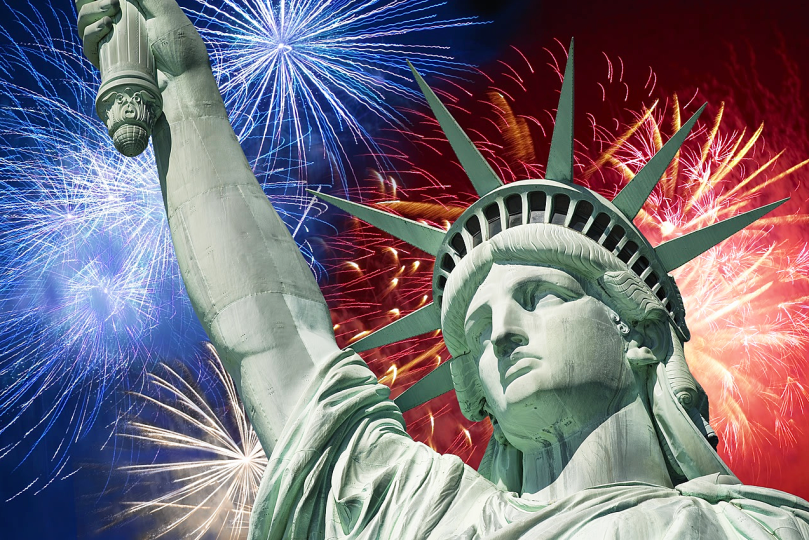
We speak here of the upcoming July 4th. Or, the Fourth of July. Or, Independence Day. Internationally, it also is known as the National Day of the United States. That’s four.

School children are taught that July 4, 1776, is when we declared our independence from England. Technically, perhaps, but that actually was done two days earlier when the Second Continental Congress voted to approve a resolution that had been proposed the month before by Richard Henry Lee of Virginia, declaring the United States independent from the rule of Great Britain.

Congress then turned its attention to the Declaration of Independence, the written statement explaining this decision, which had been prepared by a Committee of Five, with Thomas Jefferson as its principal author. It debated and revised the wording of the Declaration, finally approving it on Thursday, July 4, the day that became one of celebration and commemoration.

That isn’t exactly what all the Founding Fathers had in mind at the time. On July 3, John Adams had written to his wife, Abigail (underlining for emphasis):

“The second day of July, 1776, will be the most memorable epoch in the history of America. I am apt to believe that it will be celebrated by succeeding generations as the great anniversary festival. It ought to be commemorated as the day of deliverance, by solemn acts of devotion to God Almighty. It ought to be solemnized with pomp and parade, with shows, games, sports, guns, bells, bonfires, and illuminations, from one end of this continent to the other, from this time forward forever more.”

While we enjoy our picnics, fireworks, parades, and games, let’s take a moment to reflect on the tremendous achievement that was wrought 240 years ago this weekend.


Today in history

Screen shot 2016-06-19 at 2.36.37 PM

On July 2 in ...

1698 — English inventor and engineer Thomas Savery is granted the first patent for a steam engine. However, he will not develop a commercially viable engine until the early 1700s.

1776 — The Second Continental Congress, representing Great Britain’s 13 American colonies,  votes to approve a resolution of independence from Britain that had been proposed in June by Richard Henry Lee of Virginia.

1823 — Brazil, the largest country in South Anerica, emerges as an independent nation after the final defeat of the Portugese crown loyalists in the province of Bahia.

1881 — Lawyer/preacher Charles Julius Guiteau, a disgruntled federal job seeker, shoots President James Garfield at the Baltimore & Potomac Railroad Station in Washington, DC. Garfield will linger until dying on September 19 from an infection caused by the bullet wound.

1964 — President Lyndon B. Johnson signs the Civil Rights Act of 1964 meant to prohibit segregation in public places.


Today in history

Screen shot 2016-06-19 at 2.36.37 PM

On July 1 in …

1770 — Lexell’s Comet passes closer to the Earth than any other comet in recorded history to that time, approaching within 0.0146 astronomical units (1,357,154.79 miles).

1863 -– The Battle of Gettysburg begins in the vicinity of the Adams County, PA, town during the Civil War.

1908 — “SOS” is adopted as the international distress signal.

1933 — Aviator Wiley Post becomes the first person to fly solo around the world, traveling 15,596 miles in 7 days, 18 hours, 45 minutes.

1963 — ZIP codes (the acronym for Zone Improvement Plan) are introduced nationwide. The delivery designation program of five digits supplanted a system of numbers for major cities that the U.S. Post Office had introduced in 1943. (An additional voluntary set of figures — the five digits followed by a hyphen and four more digits — was introduced in 1983.)


Today in history

Screen shot 2016-06-19 at 2.36.37 PM

On June 30 in …

1559 — During a jousting match, a splinter of wood from the shattered lance of Count Gabriel de Lorges pierces the eye of King Henry II of France, mortally wounding him. From his deathbed, Henry absolves De Lorges of any blame.

1859 — French acrobat Charles Blondin crosses Niagara Falls on a tightrope.

1906 — The Congress of the United States passes the Meat Inspection Act and the Pure Food and Drug Act.

1937 — The world’s first emergency telephone number, 999, is introduced in London.

1997 — The United Kingdom transfers sovereignty over Hong Kong to the People’s Republic of China.


Today in history

Screen shot 2016-06-19 at 2.36.37 PM

On June 29 in …

1613 — In London, the original Globe Theater, among whose owners is William Shakespeare, burns to the ground. It will be rebuilt on the same site in 1614.

1767 —  The British Parliament approves the Townshend Revenue Acts, imposing import duties on glass, lead, paint, paper, and tea shipped to America. (Colonists bitterly protested, prompting Parliament to repeal the duties on all goods, except tea, in 1770.)

1776 –- Father Francisco Palou founds Mission San Francisco de Asis in Alta California. It eventually will grow to be the modern city of San Francisco.

1889 — Hyde Park and several other Illinois townships vote to be annexed by Chicago, forming the largest United States city in area and second largest in population.

1928 — Pilot Albert Hegenberger and co-pilot Lester Maitland accomplish the first nonstop flight from California to Hawaii, flying the modified transport Bird of Paradise.


Have you saved these summer dates?

SRC Summer Chart

Here’s what we’ll be doing as a club — including family and friends — in July and August. We hope you’ll be interested in taking part in as many activities as possible.

Please note we still have one date open in August, and we’re looking for someone or several someones to step forward to host or coordinate an event. Please contact incoming President Debbie Rodriguez if you’re interested in doing so.


Today in history

Screen shot 2016-06-19 at 2.36.37 PM

On June 28 in …

1778 — Mary Hays McCauley, wife of a Colonial artilleryman, carries water to the American soldiers during the Battle of Monmouth against British troops in Monmouth County, NJ. She becomes known as “Molly Pitcher.”

1894 — The U.S. Congress approves legislation making Labor Day an official national holiday.

1914 — Archduke Franz Ferdinand, heir to the Austro-Hungarian throne, and his wife, Duchess Sophie, are assassinated in the city of Sarajevo, helping touch of World War I. On this same date five years later, the Treaty of Versailles is signed, ending the war.

1971 — The Supreme Court of the United States overturns the draft evasion conviction of boxing great Muhammad Ali.

2007 — The American bald eagle is removed from the endangered species list.